
Shadow Work: When Your Un-lived Life Looms

Winter Poem
The quivering wings of the winter ant
wait for lean winter to end.
I love you in slow, dim-witted ways,
hardly speaking, one or two words only.What caused us to live hidden?
A wound, the wind, a word, a parent.
Sometimes we wait in a helpless way,
awkwardly, not whole and not healed.When we hid the wound, we fell back
from a human to a shelled life.
Now we feel the ant’s hard chest,
the carapace, the silent tongue.This must be the way of the ant,
the winter ant, the way of those
who are wounded and want to live:
to breathe, to sense another, and to wait.— Robert Bly
Perhaps all the dragons in our lives are princesses who are only waiting to see us act, just once, with beauty and courage. Perhaps everything that frightens us is, in its deepest essence, something helpless that wants our love.
— Rainer Maria Rilke
As you tread onward in life, there are parts of yourself that you (sometimes intentionally and other times unintentionally) leave behind. Those parts do not go away. They accumulate. They are your shadow. One of the most essential aspects of honing your inner life is going into the dark and bringing out those parts into the light.
In this post, I would like to take you on a journey about owning your shadow-self by going through the first chapter of the Jungian analyst Robert A. Johnson’s book Owning Your Own Shadow.
How do we create our shadow?
The author describes the shadow as the part of us we fail to know. He elaborates,
“We all are born whole and, let us hope, will die whole. But somewhere early on our way, we eat one of the wonderful fruits of the tree of knowledge, things separate into good and evil, and we begin the shadow-making process; we divide our lives. In the cultural process we sort out God-given characteristics into those that are acceptable to our society and those that we have to be put away. This is wonderful and necessary, and there would be no civilized behaviour without this sorting out of good and evil. But the refused and unacceptable characteristics do not go away; they only collect in the dark corners of our personality. When they have been hidden long enough, they take on a life of their own – the shadow life.”
Johnson’s description is steeped in biblical motifs (he did study at a monastery at one point); however, we can see the relevance of what he says about how the shadow originates. It seems that the shadow is made while we are trying to please other people. It comes out of our fears, desires, whims, and illusions. Shadow-making is an inescapable part of our humanity. It is a survival mechanism. However, if we are trying to elevate ourselves from survival-mode to, say, creative-mode, shadow work (facing our dark side) is an absolute requirement.
“The shadow is that which has not entered adequately into consciousness. It is the despised quarter of our being. It often has an energy potential nearly as great as that of our ego. If it accumulates more energy than our ego, it erupts as an overpowering rage or some indiscretion that slips past us; or we have a depression or an accident that seems to have its own purpose. The shadow gone autonomous is a terrible monster in our psychic house.”
The quote above is the nugget of Johnson’s book, which is an absolute eye-opener when read in its entirety. The idea that we refuse parts of our personality to fit into the ‘tribe’ or the ‘group’ is not necessarily a revelation; however, if we ponder that further, we realize that the consequence of rejecting parts of ourselves can be far-reaching.
“We divide the self into an ego and a shadow because our culture insists that we behave in a particular manner.”
The ego is our conscious self. It is the facade that we carry around. We usually work hard to maintain that facade. The shadow is the dumping ground of all our negative traits.
“One can make a forceful argument that children should not be subjected to this division too soon or they will be robbed of childhood; they should be allowed to remain in the Garden of Eden until they are strong enough to stand the cultural process without being broken by it.”
This issue can be controversial. It can be argued that school, the second form of a cultural institution after the family, can cause this initial internal split. However, Johnson continues, “It requires a keen eye to know when children are ready to adapt to the collective life of a society.” This topic is far too wide to be discussed here. However, we need to contemplate how unhealthy cultural constructs may cause internal divisions within individuals.
Further on, if we look around the world, what one country considers acceptable the other country does not, which means that the attributes that go under the ego, and the ones that go under the shadow, may differ from one country to another.
“It becomes clear that culture is an artificially imposed structure, but an absolutely necessary one.”
The sorting process may seem haphazard. Individuality, for instance, is a virtue in some societies and the greatest sin in others. The conflict between such views may cause internal and external mayhem in a world where an expansive communication network continues to bring everything and everyone closer.
“The shadow of one culture is a tinderbox of trouble for another.”
It is not all doom and gloom. We are reminded that the shadow is also the dumping ground of positive traits we are afraid to manifest; this will be explored further (keep reading!).
“Some of the pure gold of our personality is relegated to the shadow because it can find no place in that great leveling process that is culture.”
Johnson elaborates it may be harder to own the gold in the closet. People find it easier to bring out the skeletons. It is easier to admit that you are a ‘loser’ than it is to face up to your innate greatness and nobility. In reality, we carry the potential for both.
“The gold is related to our higher calling, and this can be hard to accept at certain stages of life. Ignoring the gold can be as damaging as ignoring the dark side of the psyche, and some people may suffer a severe shock or illness before they learn how to let the gold out.”
The intensity of an experience, such as an illness or losing a loved one, can be the vehicle that forces us to expunge the goodness within us. It echoes the archetype of the wounded healer who learns how to identify their ailment, discovers their wholeness, and then works to heal others.
Whatever the case may be, part of becoming an adult is to arrive with a sense of brokenness inside – humbled but fully aware of one’s potential to achieve wholeness.
“The religious process consists of restoring the wholeness of the personality. The word religion means to re-relate, to put back together again, to heal the wounds of separation. It is absolutely necessary to engage in the cultural process to redeem ourselves from our animal state; it is equally necessary to accomplish the spiritual task of putting our fractured, alienated world back together again.”
Interestingly, Johnson refers to ‘shadow work’ as a religious process. It is crucial to understand his nuanced explanation, especially since the role of religion can be ambiguous, sidelined, or manipulated for worldly gains!
The process of shadow-making is inevitable, and without it, there would be no culture. However, one must spend the second part of life recovering that division.
“Generally, the first half of life is devoted to the cultural process – gaining one’s skills, raising a family, disciplining one’s self in a hundred different ways; the second half of life is devoted to restoring the wholeness (making holy) of life.”
If we lose ourselves in this passageway, we may fail to individuate fully. We can say that the first half of life is unconscious, rushed, and unfulfilled. It seeks only the outward aspect of things, while the second half of life is the direct opposite. Being stuck between both is the determent.
“Unfortunately, many Westerners are caught in just this difficult phase.”
Johnson’s book was published in 1991. Almost twenty-six years later, we can argue that nowadays, not only Westerners find themselves caught up in this phase. In fact, due to the rise of a somewhat ‘homogenous’ global culture, more and more people are finding themselves stuck in this middle passageway. Especially since things like rites of passage, spiritual rituals, and communal living are deemed obsolete and, in some ways, are replaced by inferior options.
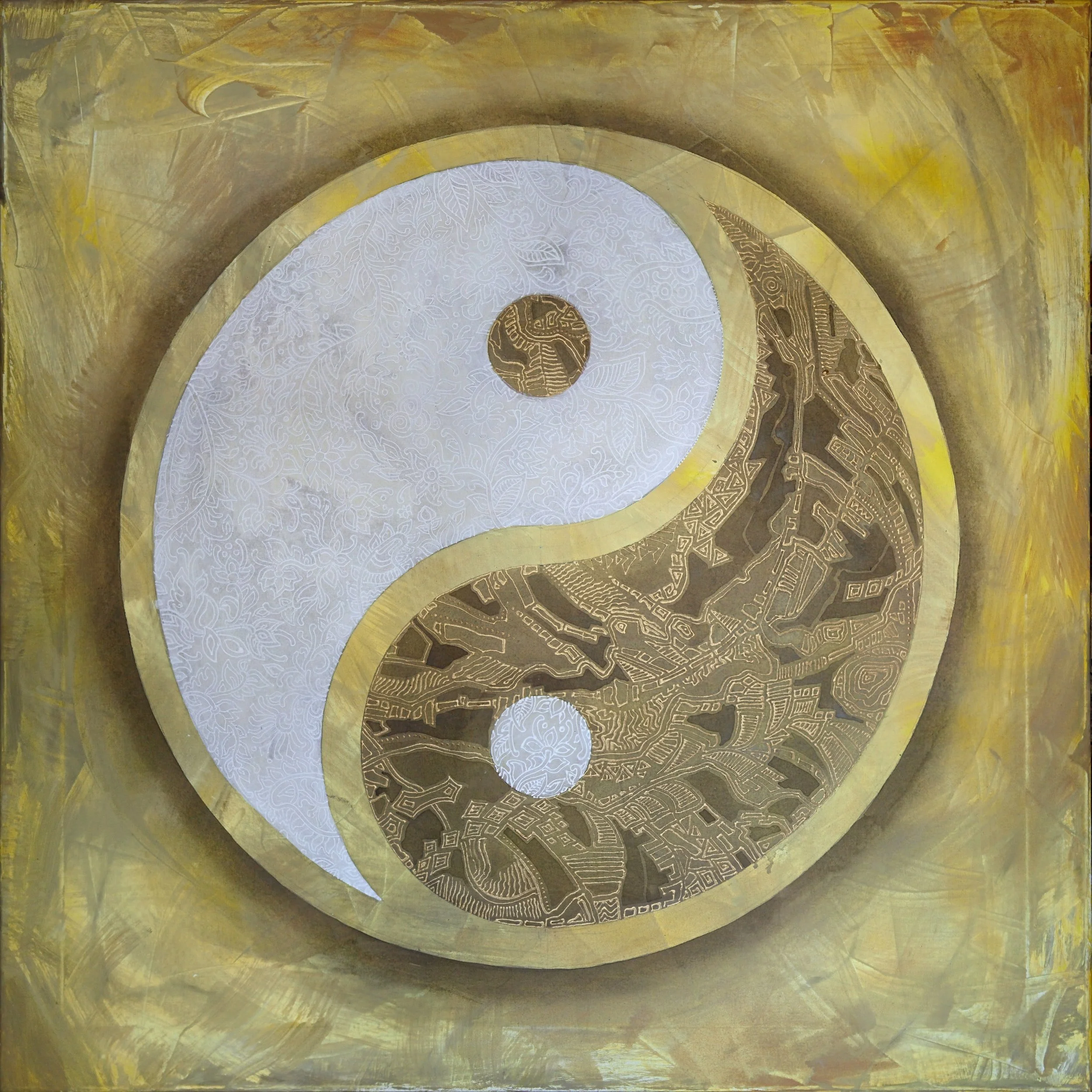
Yin and yang (/jɪn/ and /jæŋ/) is a Chinese philosophical concept that describes opposite but interconnected forces. In Chinese cosmology, the universe creates itself out of a primary chaos of material energy, organized into the cycles of yin and yang and formed into objects and lives.
Balancing Culture and Shadow
“A cultured person is one who has the desired characteristics visible on the right (the righteous side) and the forbidden ones hidden on the left. All our characteristics must appear somewhere in this inventory. Nothing may be left out.”
Since “nothing may be left out,” Johnson showcases the personality as a “teeter-totter or see-saw” that balances the right side and the left side, and in our passage to wholeness, we must balance both of these sides. In some sense, wholeness is the fulcrum. Suppose one understands that their personality sways too far to the left; one must try to balance it out by assuming traits from the right and so on. For instance, if someone enjoys frivolity a bit too much in their life, they must try to consider some seriousness, but if someone is too severe in their life, they may need to assume some frivolity. Extremes appear when one side becomes heavier than the other side, and the seesaw flips.
“The alcoholic who suddenly becomes fanatical in his temperance, or the conservative who suddenly throws all caution to the wind…”
Taking the image of the see-saw even further, he argues that the see-saw may also break! “This is a psychosis or breakdown.” Just like the body seeks equilibrium through its temperature and its acid-alkaline ratio, the psyche does the same. Hence, the psyche is always seeking a state of balance. If someone cannot achieve balance, dire consequences may become apparent in one’s life – frustration, anxiety, depression, anger, or burnout.
Goodness and sainthood, the author argues, are not about living the right side and ignoring the left side. This one-dimensional view of a saint is a societal construct. Almost all authentic spiritual teachings relay stories of saints as regular human beings who had to go through their own “hero’s journey.” Who had to face their left side, or their dark side, to earn the right to pass on to wholeness. Authentic goodness acknowledges darkness and keeps it in check.
It does not mean that we go around parading our ‘darkness’, constantly.
“We must hide our dark side from society in general, or we will be a bloody bore; but we must never try to hide it from ourself. True sainthood – or personal effectiveness – consists in standing at the centre of the seesaw and producing only that which can be counterweighted with its opposite. This is far from the sentimental view of goodness that has been set up as our ideal.”
Johnson quotes St. Augustine, who says, “To act is to sin.” In the Hindu tradition, Brahma, the god of creation, is in juxtaposition to Shiva, the god of destruction, while Vishnu is the fulcrum. In the Sufi tradition, a genuine sheikh/mentor/teacher carefully guides the disciple through subtle inner work required to bring out the shadow. This universal process occurs in any authentic spiritual tradition; while it may be pretty uncomfortable, it is necessary.
“The balance of light and dark is ultimately possible and bearable. All nature lives in polarity – light, and dark, creation and destruction, up and down, male and female. It is not surprising that we find the same basic laws functioning in our psychological structure.”
To admit that there are more sides to us than we know is to acknowledge that we have no control over our lives. In a way, we have no control over who we are, but that’s not entirely accurate. We only have no control when our awareness is weak. The more aware we become, the smaller our shadow will become.
We can consider here how a culture steeped in social media creates its shadow. The shadow does not only build up on an individual level, but it also builds up on a collective level. People present themselves in a specific way. They capture the “perfect” moments in their lives. They get immediate feedback. Their sense of self or the illusion of their sense of self becomes bolstered with every ‘like’ and positive feedback, which perpetuates an image of perfection (light), which produces more shadow (dark) as compensation.
“To make light is to make shadow; one cannot exist without the other.”
Some people living out their creativity, preeminent artists, lead complicated private lives. Being admired and being in the public eye constantly is suffocating. Space is needed to expel the shadow side.
On another level, our technologically advanced society has its own collective shadow. While we are overly connected with everyone, we still suffer boredom and loneliness. The high ‘creativity’ of our modern society, Johnson argues, needs to pay out its shadow in an intelligent way.
On our path to wholeness, we must seek a more authentic way of being. Simple. Uncomplicated.
In relationships,
“Many a woman is burdened by paying out the dark side of a creative man; many a man is drained by carrying the dark side of a woman that is the byproduct of her creativity. Worst of all, children often have to carry the dark side of creative parents. It is proverbial that the minister’s child will be difficult and the wealthy man’s child is in danger of leading a meaningless life”.
It is interesting to consider the idea of projecting our shadow onto others, especially children. One of Jung's clients went to see him because he could not dream. Jung started analyzing the client through his client's son's dreams. Jung learned that the man's son had elaborate, vivid dreams. Further into analysis, the son stopped having vivid dreams, and the father 'reclaimed' back his nightly dreams. He reclaimed his psychic world.
Consider how much burden children carry when their parents are holding a dark shadow. Consider how much burden one partner has, even if it is on an unconscious level when the other partner carries a heavy shadow.
If the darkness within you is not acknowledged, it will turn up in different forms.
“Does this mean that I have to be as destructive as I am creative, as dark as I am light?”
The reader is called upon the ultimate question, “How, then, can one produce something of beauty or goodness without doing an equal amount of wreckage?” We must, therefore, ritually acknowledge this other dimension of reality.
“The unconscious cannot tell the difference between a “real” act and a symbolic one.”
Johnson gives examples of symbolic acts that may expel the shadow. If you were a writer, and – say – you just finished composing a piece of work of high merit. You, then, should let go and write something that seems ‘low-grade.’ Or if you were a classically trained musician involved in sophisticated compositions that are highly complicated and nuanced. Perhaps listening to some pop music or a piece that is out of tune is a way to “pay your dues” to the shadow side.
“Much of religious ceremony is designed to keep the left-hand side of the balance functioning in a compensatory way,” Johnson asserts. Religious acts seek to balance the mundane (dark) and the sacred (light). The author admits that, as modern people, we must always find new ways to seek wholeness.
A different perspective on the act of devotion. Some may choose to devote themselves to God, a Higher order, while others may devote themselves to a social cause or political belief. In devotion, we seek refuge in something Higher, which shrinks our ego. Devotion must expand our consciousnesses. It must nourish us intellectually, spiritually, and physically. If our devotion is a source of constriction and causes us to see ourselves as better than the ‘other,’ we must then question our intentions and authenticity. It means we still need more time with our shadow-self.
“To refuse the dark side of one’s nature is to store up or accumulate the darkness; this is later expressed as a black mood, psychosomatic illness, or unconsciously inspired accidents. We are presently dealing with the accumulation of a whole society that has worshiped its light side and refused the dark side, and this residue appears as war, economic chaos, strikes, racial intolerance. The front page of any newspaper hurls the collective shadow at us.
…
We must be whole whether we like it or not; the only choice is whether we will incorporate the shadow consciously and with some dignity or do it through some neurotic behaviour.”
To repair the ailments that plague society as a whole, we must, as individuals, ponder our interior life and seek to rectify its imbalances. The internal health of its people determines the health of a community. The person who seeks to amend their internal imbalance is not only helping themselves. They are also helping society as a whole.
Not everyone will be able to achieve wholeness. Not everyone is meant to earn it. However, those who have been able to reach it can handle relations with other people with more wisdom and grace since they have worked on removing their projections.
The Shadow in Projection
“Unless we do conscious work on it, the shadow is almost always projected; that is, it is neatly laid on someone or something else so we do not have to take responsibility for it.”
In our society, whole businesses target the projection of our (the consumer’s) shadow. We can look at the latest trends on TV shows or social media to see what’s being projected.
“We are left as less than whole personalities when we invest our own darkness into something outside ourselves. Projection is always easier than assimilation.”
Taking the concept of shadow projections into the collective consciousness, Johnson asserts,
“Men lay their shadow upon women, whites upon blacks, Catholics upon Protestants, capitalists upon communists, Muslims upon Hindus. Neighbourhoods will make one family the scapegoat and these people will bear the shadow of the entire group.”
Media is undoubtedly one of the primary business outlets that target the collective shadow. They always use a scapegoat or a bogeyman as a form of distraction, perpetuating a kind of intellectual numbness. A mere scan of current events reveals the ailments our society carries on an internal level.
It seems that this pathology can also manifest in children. One of the primary paths to individuation is for people to work on throwing off their parent’s shadow. A burden that some may carry from childhood comes in the form of a parent’s unfulfilled needs. The parent projects their internal disparities onto one particular child in the family (the black sheep). Sometimes the target is all the children.
“If a parent lays his shadow on a young child, that splits the personality of the child and sets the ego-shadow warfare into motion.”
The larger the shadow the parent casts upon the child, the harder it is for the child to lift the projection. As such, that child may grow up struggling with the cultural shadow and the parent’s shadow. When the child becomes an adult, they end up casting their shadow upon their children, a family pathology that perpetuates itself, creating intergenerational trauma.
“If you wish to give your children the best possible gift, the best possible entry into life, remove your shadow from them. To give them a clean heritage, psychologically speaking, is the greatest legacy.”
It is easy to belittle the amount of suffering handed from one generation to another, Johnson argues. The buck passes from one person to another. It is time to stop passing the buck around. It is time to stop passing on the shadow.
Johnson relays a story of one of his patients: a female whose husband retired. The woman was reduced to tears daily by her husband's shadow projection. Johnson advised his patient that she must deflect her husband's projection and not fight back or retreat into solitude. Just deflect the attacks like a matador deflects the bull. The shadow must then retract to its source, her husband.
“You can refuse shadow projection and stop the endless cycle of revenge if you have your own shadow under conscious control. To be in the presence of another’s shadow and not reply is nothing short of genius. No one has the right to dump his shadow on you, and you have the right to self-protection.”
Shadow projection is a subtle form of psychological abuse. Sometimes you may have to wait and let the shadow projection runs its course, and this can only happen when we have our own shadow reasonably well in hand, and we are not tempted to plan our retaliation.
Being able to shed our shadow helps us understand the meaning of what it means to love your enemy.
The Gold in the Shadow
Here the author takes us from the ‘bad’ side of the shadow to the ‘good’ side.
“Our hero-worshipping capacity is pure shadow; in this case our finest qualities are refused and laid on another. It is hard to understand, but we often refuse to bear our noble traits and instead find a shadow substitute for them.”
The author quotes Jack Sanford, an Episcopal priest.
“The ego is…primarily engaged in its own defense and the furtherance of its own ambitions. Everything that interferes with it must be repressed. The [repressed] elements…become the shadow. Often these are basically positive qualities.
There are, in my view, two “shadows”: (1) the dark side of the ego, which is carefully hidden from itself and which the ego will not acknowledge unless forced to by life’s difficulties, and (2) that which has been repressed in us lest it interfere without egocentricity and, however devilish it may seem, is basically connected to the Self.
In a showdown God (Self) favors the shadow over the ego, for the shadow, with all its dangerousness, is closer to the center and more genuine…”
The above quote is a fantastic summary of the concept of the shadow. However, Johnson admits that we live in a time that does not like to hear about the dark and light side of human nature. The modern human wants to tread on, make money, and live a dull life.
As long as we live in this state, suffering and conflict will remain a persistent part of our humanity. If you can get in touch with your own shadow, and do something out of your usual pattern, lots of energy will flow.
The Shadow in Middle Age
Johnson, here, discusses midlife crisis, a largely misunderstood topic. Why do some individuals find themselves stuck in midlife? Perhaps, we have finally grown sick of an imbalanced see-saw. The time has come to seek out a meaningful life and find the middle way. We may think that the middle way is a compromise, a dull grey zone when in reality, it is a place of ecstasy and joy!
Many wisdom traditions call upon the middle way. Taoism, for instance, which hails from ancient China, is about finding balance through “creative synthesis.” It is a form of art. One cannot stay in that perfect balance for a long time; however, moments of it or glimpses of it will suffice.
The early half of life is about discipline and cultivating life. In the middle half of life, some people may choose to walk away from what’s familiar and take an entirely different direction. Johnson mentions another story of one of his patients who worked as an artist. He only drew eyebrows for various types of comics and was excellent at drawing expressive eyebrows. However, one day he looked at his work, swore out loud, and stormed out of his office and right into therapy. While this might sound like an extreme example, many people may feel the same way, but only a few act upon it.
“I told him he had totally exhausted that part of his life and would have to contact the unlived shadow if he wished to find a new vitality. Being a very nice person, he had a hard time making that contact.”
To confront their own shadow (their demons), many nice people may have to become a tad not nice!
The Ceremonial World
“Medieval heroes had to slay their dragons; modern heroes have to take their dragons back home to integrate into their own personality.”
We must live out the contents of the left side of the personality without damaging the right side. The psyche does not differentiate between the outer world and the inner world. It does not recognize linear time! Therefore, Johnson argues, symbolic ceremonies and rituals are an integral part of unveiling the shadow.
“Culture can only function if we live out the unwanted elements symbolically. All healthy societies have a rich ceremonial life. Less healthy societies rely on unconscious expressions: war, violence… Ceremony and ritual are a far more intelligent means of accomplishing the same thing.
Ceremonies the world over, and from every age, consist mostly of destruction: sacrifice, burning, ritual killing, bloodletting, fasting, and sexual abstention. … It is easy to fall into the error of thinking that we protect the culture by obliterating the destructive elements.
…
That is why a true religious ceremony has to contain as much darkness as light.”
We cannot deny that many spiritual traditions require ceremonial, ritualistic practices meant to serve the shadow in some way. These may come in various forms: joyous ceremonies, rhapsodies, devotion, and even bloodletting. Bloodletting or cupping is an ancient practice in Ayurvedic medicine, the Talmud, and the prophetic teachings of Mohammed ﷺ in Islam. A cup is placed on the skin after an incision, and blood is drawn out of the body at specific points and in a precise manner. It is supposed to remove ‘unclean’ blood or, in other words, negative energies of various forms, including physical ailments. The practice goes back to ancient Egypt, China, Persia, and Greece. Many scientific studies corroborate the benefits of cupping.
“All of this flies very much in the face of traditional thinking. Our present model seems to be that if we can do something sufficiently creative, that will overwhelm the dark forces and we will have triumphed. But a very different solution is required.”
Ritual devotion to something higher is a necessary spiritual medicine. Still, we must comprehend that what is meaningful to one person may not be for another, or else it becomes indoctrination.
Perhaps, the size of the shadow is so big, and its nature too ambiguous, and as such, we need to hold various form of sacred ceremonies that are meaningful to the individual and the collective.
The tension between dark and light, yin and yang, is a treasure that the modern human is unaware of.
“Our fate can truly be altered if we have the courage to embrace the opposites.”
And hopefully, this is how we tread toward the path of enlightenment and liberation.
Thank you for reading! If you have any comments or questions or corrections please email: info@integrativepractice.ca.